Trenchless vs Traditional Sewer Line Replacement
HomeGuide prices sewer line replacement at $50–$250 per foot and trenchless lining at $90–$250 per foot, so on the pipe alone the two overlap. A conventional dig is often the cheaper job under bare lawn; trenchless usually wins once a driveway, patio, mature trees or a slab sit over the pipe.
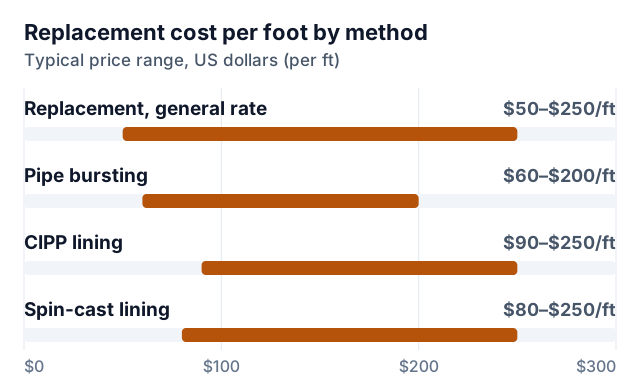
Searching for no-dig sewer repair usually means one question: is trenchless worth it compared with digging the old pipe up? On the pipe alone, often not. HomeGuide's December 2025 data puts sewer line replacement in general at $50 to $250 per linear foot, and its trenchless rates overlap that band: pipe bursting at $60 to $200 per foot and cured-in-place lining (CIPP) at $90 to $250 per foot.
The answer flips when you price what sits on top of the line. HomeAdvisor's June 2026 guide puts yard restoration after a trench at $1,200 to $6,200, a driveway repair at around $1,700 and a patio resurfacing at about $1,400, and trenching under a foundation at $150 to $200 per foot. Trenchless methods leave most of that surface alone, which is where their savings come from.
This page lays the two approaches side by side: what each costs on a typical lateral, how long the result lasts, which pipe conditions rule each one out, and a short checklist for choosing. Sewer Line Repair Pros connects you with independent local sewer contractors; they quote their own work after a camera inspection, and the figures below are national survey ranges, not quotes.
Typical national range
$2,000 – $15,000
HomeGuide's replacement totals run $2,000–$10,000 for a 40-ft line and $3,000–$15,000 for 60 ft; its trenchless per-foot rates ($60–$250) land in the same band before restoration is counted.
Cost breakdown
| Item | Typical range | Notes |
|---|---|---|
| Sewer line replacement, general rate | $50 – $250 | Per linear foot, HomeGuide's overall replacement figure, before surface restoration. |
| Trench digging only (traditional) | $5 – $12 | Per linear foot, HomeGuide; the excavation itself, by depth and obstacles. |
| Trenchless boring only | $10 – $30 | Per linear foot, HomeGuide; horizontal or directional boring instead of a trench. |
| Pipe bursting (trenchless replacement) | $60 – $200 | Per linear foot, HomeGuide; pulls a new pipe through the old one between two access pits. |
| Cured-in-place lining (CIPP, trenchless) | $90 – $250 | Per linear foot, HomeGuide; a resin liner cures inside the old pipe. |
| Spin-cast lining (trenchless) | $80 – $250 | Per linear foot, HomeGuide; resin sprayed onto the pipe wall instead of a sleeve. |
| Trenching under a slab foundation | $150 – $200 | Per foot, HomeAdvisor; the case where digging gets expensive fastest. |
| Yard and landscape restoration after a trench | $1,200 – $6,200 | HomeAdvisor range; trenchless leaves most of the yard untouched. |
| Sewer camera inspection | $125 – $500 | HomeGuide range; decides which method the pipe qualifies for. |
| Plumbing permit | $30 – $500 | HomeGuide range; set by your city or county either way. |
What changes the price
Providers quote their own work — these are the factors that consistently move the number.
- What is above the pipe: HomeGuide lists concrete removal at $3 to $8 per square foot and major driveway repairs at $600 to $3,000, costs that a trench pays and a lining job mostly avoids.
- Line length and depth: HomeGuide's replacement totals scale from $500–$2,500 for 10 ft to $4,000–$20,000 for 80 ft, and deeper trenches need shoring and bigger machines.
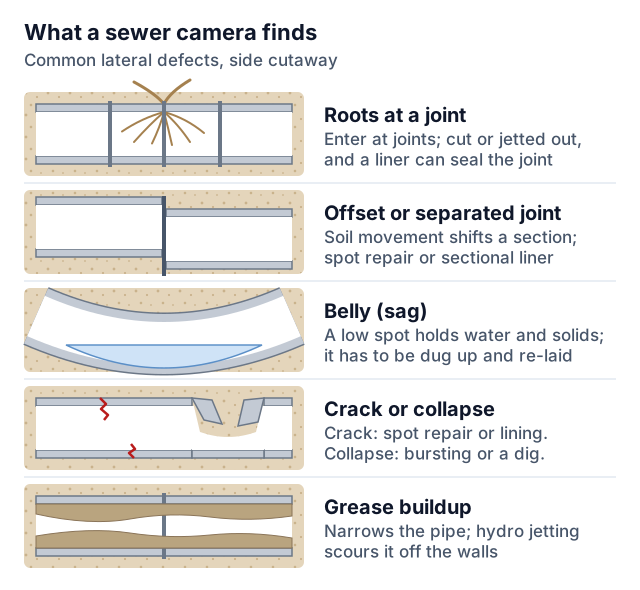
- Pipe condition: a lining needs a host pipe that still holds its shape, so a collapsed or badly sagging section forces bursting or a dig regardless of price.
- Access pits: bursting needs a launch pit and a receiving pit, so a lot with no room at either end can push the job back to open trench.
- Restoration scope: HomeGuide puts landscaping at $4 to $12 per square foot and sod at $1 to $2 per square foot, so a long trench through finished landscaping adds up quickly.
- Local labor and permits: HomeGuide lists plumbers at $75 to $150 per hour and permits at $30 to $500, which moves both methods by the same local factor.
Cost on a typical 60-foot lateral
Take a 60-foot line from the house to the street. HomeGuide's own size table puts replacing 60 feet of sewer line at $3,000 to $15,000. Applying HomeGuide's per-foot rates to the same 60 feet gives $3,600 to $12,000 for pipe bursting and $5,400 to $15,000 for CIPP lining (our arithmetic from those rates, before access pits or cleanouts).
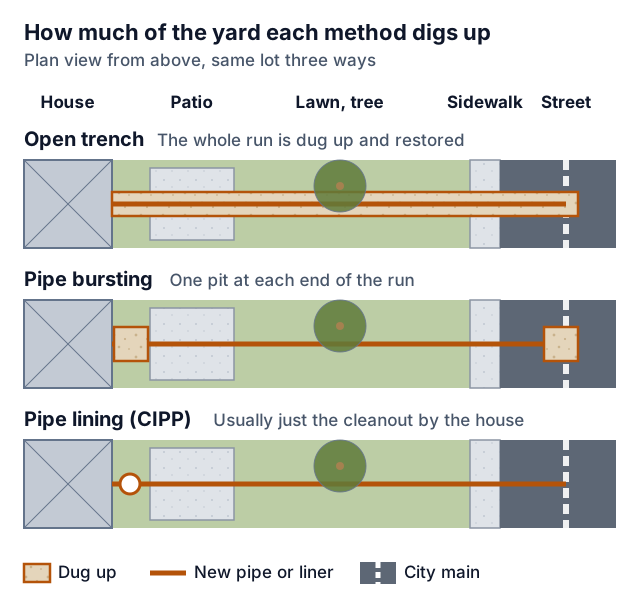
On pipe cost alone, the totals overlap, and a straightforward dig often lands at the low end of HomeGuide's band. Add the surface, though: under HomeAdvisor's ranges, putting a torn-up yard back runs $1,200 to $6,200, and a driveway repair averages about $1,700. If the line runs under a slab, HomeAdvisor's $150 to $200 per foot for under-foundation trenching makes trenchless the cheaper path almost every time.
Use the sewer line replacement cost calculator with your own footage and surface to see both totals, and treat the result as a starting point for comparing written bids.
How each method works
Traditional replacement exposes the whole pipe in an open trench, removes it and lays new pipe, usually PVC, on a fresh bed before backfilling. It handles any failure, including a fully collapsed pipe, a wrong slope or a belly that holds water, because the crew can re-grade the line as it goes.
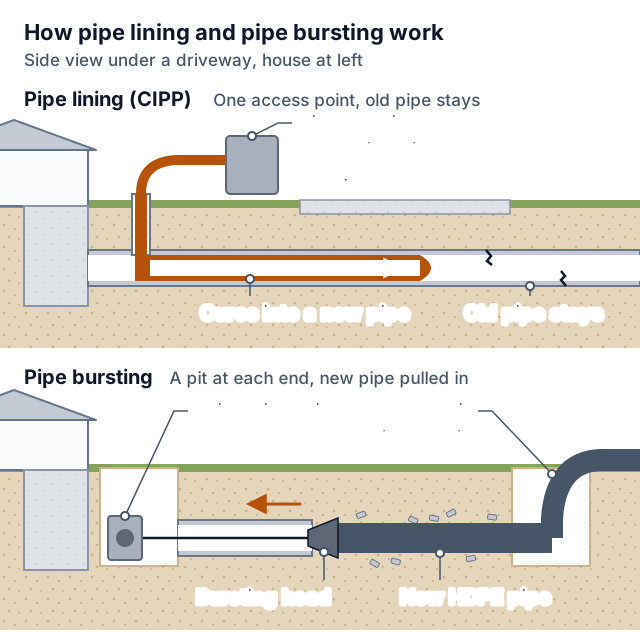
Pipe bursting pulls a bursting head through the old line from one pit to another. The head fractures the old pipe outward while dragging a new pipe in behind it, so you end up with a new line on the old path. Lining (CIPP) leaves the old pipe in place: a resin-soaked sleeve is inverted or pulled in, then cured so it hardens into a pipe within a pipe. HomeGuide notes that trenchless replacement takes less time than digging trenches.
Lifespan: how long each option lasts
A dig-and-replace job or a burst replacement installs new pipe, so its life is the life of that material. HomeGuide says PVC, cast iron and copper sewer lines last 50 to 100 years, while older clay and Orangeburg lines last 30 to 60 years, which is why many of the lines being replaced today are clay or Orangeburg.
For lining, the best public evidence is an EPA retrospective study (EPA/600/R-12/004, 2012). EPA researchers retrieved CIPP liner samples from municipal sewers in two cities after 25, 23, 21 and 5 years of service and found the samples in excellent condition. The report says there is no reason to expect those liners to fall short of their intended 50-year life. Those were city mains, not house laterals, so treat it as evidence about the material rather than a promise for any one install, and ask the contractor what the liner warranty covers.
When trenchless is not an option
Lining needs something to line. If the camera shows a collapsed section, missing pipe or a severe belly where water and solids pool, a liner will copy that defect, so the contractor will quote bursting or a dig. Bursting needs room for its two pits and a route that can take the new pipe, and very deep or tightly bent lines can push it back to open trench.
Our trenchless sewer repair candidacy tool walks through these questions before you call anyone. A camera inspection, which HomeGuide puts at $125 to $500, is the step that settles it, and it is worth asking each bidder for the video and the footage reading at each defect.
Which to choose
Choose traditional replacement when the line runs under open lawn or soil, the pipe has collapsed or sags, or the slope itself needs fixing. Choose trenchless when the line runs under a driveway, patio, mature trees, a garden or a slab, when the pipe is cracked or root-damaged but still holds its shape, or when you need the line back in service quickly.
In both cases, compare bids on the same footage, depth and restoration scope, and make sure each quote says who pulls the permit and who restores the surface. Browse our local sewer line repair pages for the permit office and rules in your area.
Frequently Asked Questions
Is trenchless sewer replacement cheaper than digging?
Not on the pipe alone. HomeGuide puts sewer line replacement at $50–$250 per foot and lining at $90–$250 per foot. Trenchless usually comes out ahead once a driveway, patio, landscaping or slab has to be broken and restored; under bare lawn a dig is often the cheaper job.
How long does a trenchless sewer liner last?
EPA's 2012 retrospective study found CIPP liners in excellent condition after 21 to 25 years in city sewers and saw no reason they would not reach their intended 50-year life. Pipe bursting installs a new pipe, so its life follows the new pipe material.
What is the difference between pipe bursting and pipe lining?
Bursting breaks the old pipe apart and pulls a new pipe into its place, so it can fix a badly deteriorated line. Lining cures a resin sleeve inside the existing pipe, so the old pipe has to keep its shape. HomeGuide lists bursting at $60–$200 per foot and lining at $90–$250 per foot.
Can every sewer line be repaired without digging?
No. A collapsed section, a severe sag or no room for access pits can rule trenchless out. Get a camera inspection first; the video shows which methods your pipe qualifies for.
Do I need a permit for trenchless sewer repair?
Usually, yes. Most cities and counties treat lateral replacement as permitted plumbing work whichever method is used, and HomeGuide puts plumbing permits at $30–$500. Your contractor normally pulls it; confirm that in the written quote.
Estimates only — independent local providers quote their own pricing. Data last reviewed 2026-10.
Sources
- HomeGuide: Sewer Line Replacement & Repair Cost (Dec 2025) (third-party estimate)
- HomeAdvisor: Sewer Line Installation Cost (updated Jun 17, 2026) (third-party estimate)
- US EPA: A Retrospective Evaluation of Cured-in-Place Pipe (CIPP) Used in Municipal Gravity Sewers (EPA/600/R-12/004, 2012)
Free tools for this job
Trenchless Sewer Repair Candidacy Checker — Lining, Bursting, or Dig?
Answer a few questions about your pipe's condition and access to see whether CIPP lining, pipe bursting, or an open trench fits — and what each costs.
Use the free tool →Sewer Line Replacement Cost Calculator
Estimate sewer line replacement or repair cost by length, method, and what's above the line — spot repair to full trenchless.
Use the free tool →Areas We Serve
Prefer to just talk to someone?
Send the short form — we'll route you to an independent local pro.