Sewer Camera Inspection
Put a camera in the line before you put money in anyone's pocket — locate roots, bellies, and breaks precisely, and keep the recording for competing bids.
- Mark an active sewage backup as an emergency
- Ask for camera footage before you accept a quote
- Local pages on laterals, trenchless repair, and jetting
- Free to use — no obligation, no markup
Fast response from independent local providers. No obligation.
Typical national cost$350 – $1,400Cost guide →About Sewer Camera Inspection
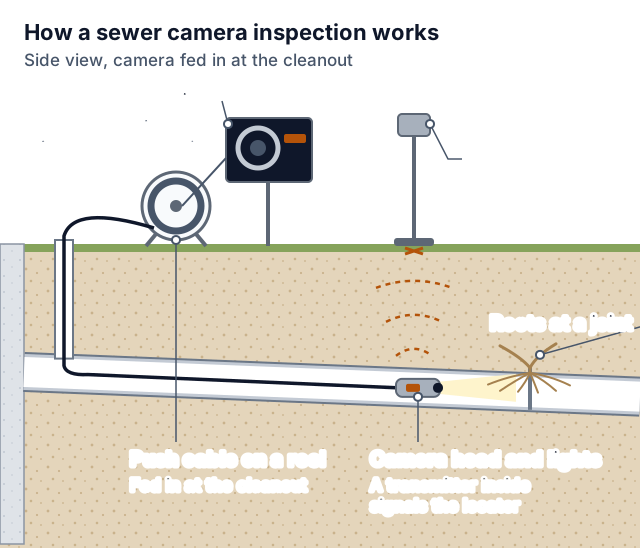
If this site has one piece of advice, it's this: put a camera in the line before you put money in anyone's pocket. A scope replaces every contractor's theory with a recording — the actual defect, its distance down the line, its depth, and which side of the property line it sits on. That footage is also your negotiating leverage: with a recording and footage-counter marks in hand, you can collect competing bids on the same evidence instead of letting each bidder re-diagnose the problem in whatever way suits their favorite repair.
We pass inspection requests to independent local providers that scope laterals. For homes built before 1980 — clay, cast iron, or Orangeburg era — a scope answers the only question that matters: how much life is left in the line, and where exactly it's failing.
Common Jobs We Route
- Diagnostic inspections for recurring clogs and slow drains
- Pre-purchase sewer scopes on older homes
- Post-repair verification that a fix actually took
- Line locating and depth marking for planned excavation
- Root intrusion and pipe-material assessment on pre-1980 laterals
- Documentation scopes for insurance claims and real-estate negotiation
What Affects the Price
Providers quote their own work — these are the factors that consistently move the number.
- Standalone inspection vs. bundled with a cleaning or repair visit — bundled scopes are often discounted
- Cleanout access: no accessible cleanout can mean pulling a toilet, which adds labor
- Line length and number of branches scoped
- Locating service, depth marking, and recorded footage deliverables
How It Works
- Step 1
Request a scope
Recurring clogs, a pending home purchase, or a quote you want verified — tell us which.
- Step 2
Local pro runs the camera
Full-length pass from cleanout to city tap, with locating and depth marks where needed.
- Step 3
You get the footage
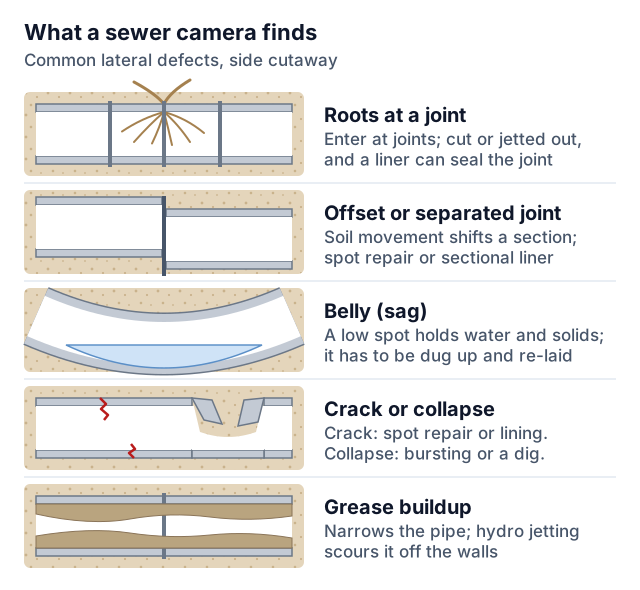
A recording and a plain-language read of what's in the line — roots, bellies, breaks, or nothing.
- Step 4
Decide with evidence
Use the footage to compare repair bids, negotiate a purchase, or confirm no action is needed.
Free Sewer Camera Inspection Tools
Get a realistic number or a quick diagnosis first — free, built on published industry data.
Sewer Pipe Lifespan Checker — by House Age & Material
Infer your sewer line's likely material from your home's build era, see where it sits on its rated lifespan, and learn when age-plus-symptoms means it's time for a camera inspection.
Use the free tool →Sewer Camera Inspection Cost Estimator & Findings Explainer
Price a standalone sewer camera inspection by access and add-ons, or decode what an existing report found — roots to Orangeburg pipe — in plain English.
Use the free tool →In an emergency?
Sewer Camera Inspection FAQs
How much does a sewer camera inspection cost?
Most run $125–$500, with around $300 typical. No accessible cleanout pushes it higher because the tech may need to pull a toilet. Recorded footage and line locating are sometimes add-ons — ask what's included.
Should I get a sewer scope before buying a house?
For homes over 30 years old, near mature trees, or built before 1980 — yes. Industry data suggests roughly half of scoped lines show some issue, and a failed lateral is a $3,000–$15,000 surprise. A few hundred dollars for a scope is cheap insurance and real negotiation leverage.
Can the camera tell what my pipe is made of?
Usually, yes — clay tile joints, cast iron corrosion patterns, Orangeburg deformation, and PVC all look distinct on camera. Combined with your home's build year, the footage tells you both the material and how much life it has left.
Sewer Camera Inspection by Area
Need sewer camera inspection?
Send the short form — no obligation.