Pipe Lining vs Pipe Bursting: Which Trenchless Sewer Repair Fits Your Line?
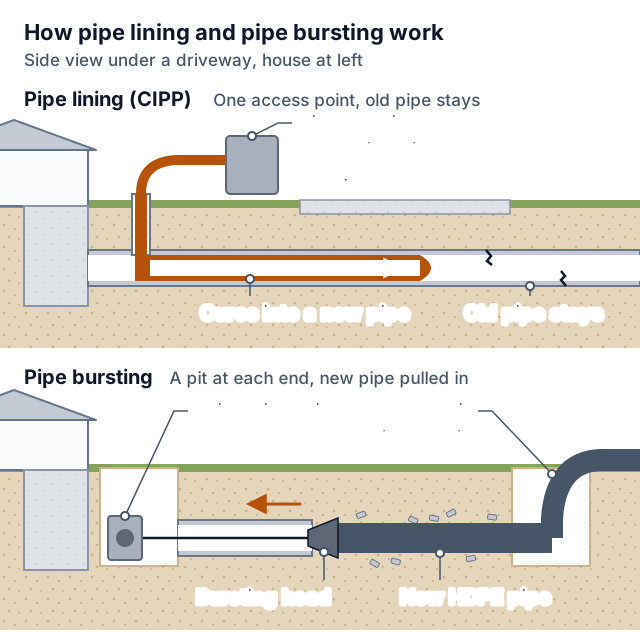
Both methods replace a sewer line without trenching the whole yard, but they suit different pipes. Cured-in-place pipe (CIPP) lining builds a new pipe inside the old one, so the old pipe has to hold its shape. Pipe bursting breaks the old pipe outward while pulling new pipe through, so it can handle pipe too damaged to line, as long as the path is still traceable.
Published 2026 pricing puts CIPP lining at $80–$250 per linear foot (Angi; HomeGuide and HomeAdvisor list $90–$250), with $125–$200 typical, and pipe bursting at $60–$200 per foot, with full lining runs commonly $6,500–$12,000 and full bursting jobs $8,000–$15,000.
At a glance
| Pipe lining (CIPP) | Pipe bursting | |
|---|---|---|
| How it works | A resin-soaked liner is pulled or inverted into the old pipe and cured in place | A bursting head fractures the old pipe while new HDPE pipe is pulled in behind it |
| Price per foot (2026 published) | $80–$250 ($125–$200 typical) | $60–$200 (some markets $150–$300) |
| Typical full job | $6,500–$12,000 | $8,000–$15,000, plus two access pits |
| Pipe condition it needs | Cracks, roots or corrosion, but the pipe still holds its shape | Badly damaged pipe with a traceable path that isn't fully collapsed |
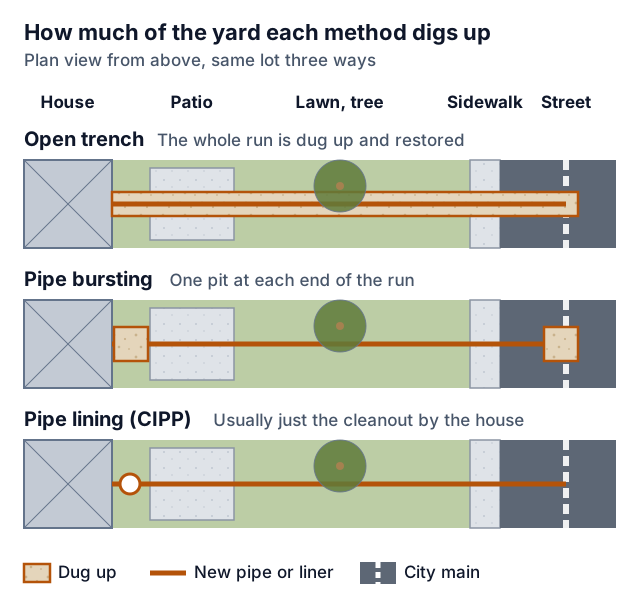
| Digging | Usually through a cleanout or one small access point | Two pits, one at each end of the run |
| Rated life | About 50 years for the cured liner | About 100 years for the new HDPE pipe |
| Pipe diameter afterward | Slightly smaller, because the liner sits inside the old pipe | Same size or larger |
Cost: per foot and all-in
On a complete job, lining usually runs about 15–20% below bursting: full lining runs commonly cost $6,500–$12,000 against $8,000–$15,000 for bursting. Per foot, the published ranges overlap ($80–$250 for lining, $60–$200 for bursting), so the per-foot rate alone won't tell you which is cheaper. For a 60-foot lateral, our replacement cost calculator puts CIPP lining at $7,500–$12,000 ($125–$200 per foot).
Either trenchless method can come in thousands below a full open trench once surface restoration is counted: the $1,500–$4,000 it can take to replace a driveway, walkway or landscaping over a trench. Under open lawn with a shallow line, though, digging is often the cheapest choice.
Which damage each method can fix
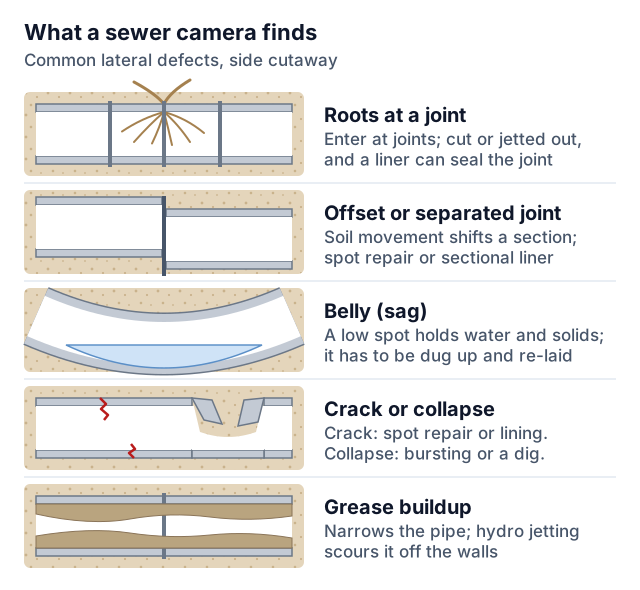
Lining needs a structurally sound host. Cracks, root intrusion at joints and interior corrosion are fine, because the liner seals over them. A collapsed section blocks the liner, and a belly or back-slope just gets lined into place, so the sag stays.
Bursting tolerates far worse pipe, including crumbling clay and Orangeburg that has started to deform, but the bursting head has to follow the old path. If the line has fully collapsed over long sections or the route is unknown, open trench or spot excavation is usually the answer.
Access, yard damage and timing
Lining usually works from a cleanout, so the yard stays largely intact. Bursting needs a pit at each end of the run; if both ends sit under concrete or structures, that can rule it out.
Both are typically finished faster than a trench replacement of the same length, but cure times, permits and the city's inspection schedule decide when you can use the line again.
Which one should you choose?
Start with a camera inspection, typically $125–$500. If the video shows cracks or roots but a round, continuous pipe and a reachable cleanout, lining is usually the lower-cost, lower-disruption choice. If the pipe is crushed, offset or deteriorated end to end but still traceable, bursting is the better fit.
Get the camera footage and a written method in every quote, and check your city's permit and right-of-way rules; some cities require a permit and inspection for any lateral work.
Frequently Asked Questions
Is pipe lining cheaper than pipe bursting?
Usually, on the complete job: full lining runs commonly cost $6,500–$12,000 against $8,000–$15,000 for bursting, about 15–20% less. Per foot the published ranges overlap, $80–$250 for lining against $60–$200 for bursting, so compare whole-job quotes.
Can a collapsed sewer pipe be lined?
No. A liner needs an open, round host pipe. A localized collapse can sometimes be dug out and repaired before lining the rest; a long collapse calls for bursting or open trench.
Which lasts longer, lining or bursting?
Cured liners are typically rated for about 50 years, and the HDPE pipe pulled in by bursting for about 100. Both far outlast the clay or cast iron they replace.
Do I need a permit for trenchless sewer repair?
Often. Many cities require a plumbing permit for lateral work, and digging pits in the right-of-way can need a separate permit. Your contractor should pull them.
Information only — not legal or financial advice. Data last reviewed 2026-10-28.
Sources
- Angi: Sewer Line Replacement or Repair Costs (updated Jul 9, 2026) (third-party estimate)
- HomeGuide: Sewer line repair and replacement cost (2026) (third-party estimate)
- HomeAdvisor: Sewer main installation and replacement cost (2026) (third-party estimate)
Need help figuring out next steps?
Send the short form — we'll route you to an independent local pro.