Sewer Backup in the Basement: What to Do Right Now
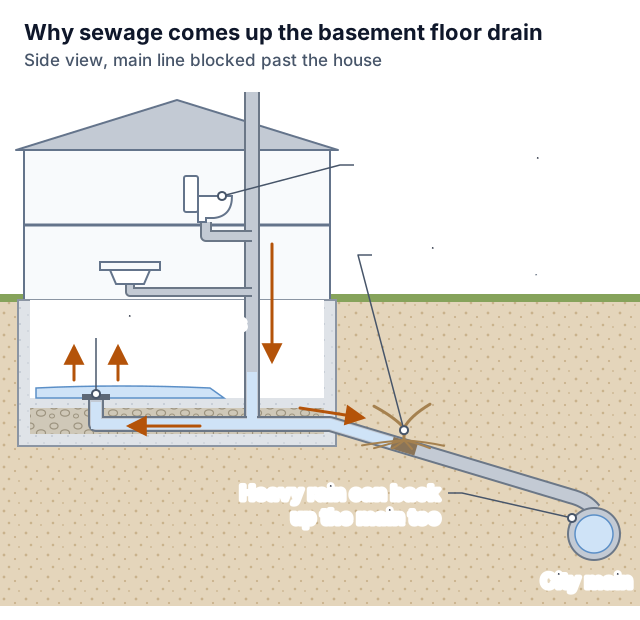
Sewage rising out of a basement floor drain or the lowest toilet almost always means the main line is blocked, either in your own lateral or, during heavy rain, in the city's system. Stop using water first; every flush upstairs ends up on the basement floor.
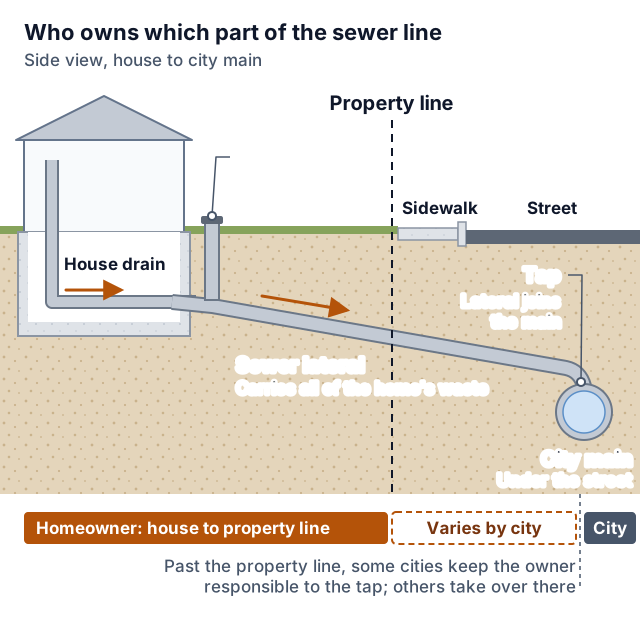
Most main-line clogs clear with a cable machine for $100–$500, or with hydro jetting for $350–$1,400 when grease or roots are involved. Whether you or the city pays depends on where the blockage is, which a camera inspection ($125–$500) can document.
If this is unsafe or getting worse right now, don't wait — send an emergency request and it's flagged for priority routing to an independent local pro.
What to do in the first 5 minutes
- Stop all water use in the house: no flushing, showers, laundry or dishwasher until the line is cleared.
- Keep everyone, especially children and pets, out of the affected area; treat the water as sewage.
- If water is near outlets, appliances or the furnace, shut off power to the basement at the panel, but only if you can reach the panel without standing in water.
- Note whether it's raining hard or neighbors have the same problem; that points to the city main, not your lateral.
- Call a sewer pro to clear the line, and call your city's wastewater or 311 line if the backup tracks with storms or affects the street.
Do not do this
- Don't wade into sewage without boots and gloves; it carries bacteria and viruses.
- Never stand in water to reach the electrical panel or unplug equipment.
- Don't pour chemical drain cleaner into a backed-up main; it won't clear it and splashes onto whoever opens the cleanout.
- Don't open a cleanout cap under pressure from the house side; sewage can surge out.
What's likely going on
Clog in your sewer lateral
Grease, wipes and debris build up where the line runs from the house to the street. A cable machine usually clears it; recurring clogs call for a camera look.
Tree roots in an older pipe
Roots enter clay and cast iron joints and catch everything that flows past. Root cutting typically adds $100–$600 to the clearing.
Storm surcharge in the city system
Heavy rain can overload the public main and push water back up into the lowest drains. A backwater valve, typically $1,000–$2,000, is the usual fix if it keeps happening.
Broken or bellied lateral
A cracked or sagging section holds water and solids. Repairs typically run $1,100–$4,100 once a camera shows where it failed.
Diagnose it now
What it typically costs
Snaking the main line typically runs $100–$500 and hydro jetting $350–$1,400; a camera inspection to document the cause is $125–$500. If the lateral is broken, repairs typically run $1,100–$4,100 (Angi) and full replacement $3,000–$15,000 (HomeGuide) depending on method and what's above the line.
Frequently Asked Questions
Who pays to fix a sewer backup in my basement?
It depends on where the blockage is. Most cities make the homeowner responsible for the lateral on private property, and some for the full run to the main. If the city main overloaded, file with the city and keep photos and the plumber's camera report.
Can I use my basement drains while waiting for a plumber?
No. Every drain in the house feeds the same main, so any water you use comes up at the lowest point. Hold off until the line is cleared.
Does homeowners insurance cover sewer backups?
Often not under a standard policy. Many insurers sell a separate water or sewer backup endorsement. Check your policy and call your agent before cleanup starts.
How do I stop sewer backups from happening again?
Keep grease and wipes out of the drains, have roots cut on a schedule if a camera shows them, and ask about a backwater valve if backups track with heavy rain.
The service that handles this
Guidance only — independent local providers assess and price their own work. Last reviewed: October 28, 2026.
Sources for the cost figures
- Angi: Sewer line replacement or repair costs (updated Jul 9, 2026) (third-party estimate)
- HomeGuide: Sewer line repair and replacement cost (2026) (third-party estimate)
- HomeAdvisor: Sewer main installation and replacement cost (2026) (third-party estimate)
Prefer to just talk to someone?
Send the short form — we'll route you to an independent local pro.